Showing posts with label observer. Show all posts

30.6.07

Living and Being


Fantasio
(You can find more of his and other excellent original artwork here.)


Life explodes and bursts ontological boundaries in its rampant and chaotic proliferation. But does life transcend being? If so, we must understand such a transcendence in the erasure of the gap between ontological layers, or in the ‘splits’ between, and productive of, generations. Such gaps are 'magically' or 'miraculously' mended by fecundity.

Being, on the other hand, never truly carries multiple names. As Deleuze emphasizes it is only ever spoken of in one sense. Yet life, if it ex-ists, must speak on uncountably many ontological layers simulatenously. If it is being which stretches and folds, that is, whose curvature is produced by motion-- then it must collapse under a folding which converges geodesics (metrically differential spaces.) Being is folded into itself, but is only itself-- which is why it cannot bear being stretched or folded without decomposing into fractal spaces: the universe of the observer.

Life, which is the highest expression of the autopoetic force, is an unfolding and self-organizing, and therefore fractally active on an infinitely complex though immanent field. Language exemplifies this sort of transcendence-within-immanence. Words are alive though language appears to enjoy an independent existence. The independent perspective is not to be found in the transparency of sense, nor the opacity of the text, nor even of the pure a-signifiying bodies around which the texts are adjoined. The independence of language from its referent is an illusion, just as the independence of perception from a subject is a rather transparent illusion.

Sensation itself is political, so nothing is neutral. Only our hypocrisy, or desire to maintain an illusory distance, is universal. This leads us to believe that a scientific study of sense would be a sort of pseudology. We call simulation the essence of the sensical because of this illusion, sense founds itself violently, through a sort of a-signifying pseudo-bifurcation. Life itself in the contamporaneity of fractally divergent ontological zones presents simulation as such, that is-- a decoding... which encodes.

Nothing escapes this.

Our very being is overcoded. Our lives are seemingly free, yet we are enslaved to the sociopolitical responsibilities of speaking. Even the creative energy which animates our bodies is treated as a sort of universal commodity, for sale on the open market. No aspect of our life or existence is free from political influence, from the process of producing separation by subdivision. No sensation as such is a-political, because sense is a differential articulation of masses.

Sense is simulation because life suffocates in ontological isolation and only exercises power, only draws surplus value from a coincident inter-relation of ontologically distinct realities, which may fractally resemble one another, but then again--may not.

In fact this fractal self-similarity is really only characteristic of the ontological unity of the immanent field of existence, which as such can only be spoken of in a single sense. There are not and could not be multiple ontologically distinct realities.

Yet life multiplies realities as independent unities, and thus all life (and sensation) in inextricably political. Life coordinates topologically complex ontological arrangements. Sense is a science of rigorous hypocrisy because living is social. Perhaps life is even ultimately one, but such that it is a one which could never be actualized as a univocity of being. Life articulates its organiazation on infinitely many layers and levels at once. We even say: life organizes the empty spaces of a mechanistic universe into an instrument for song...

12.6.07

Agency and Chaos


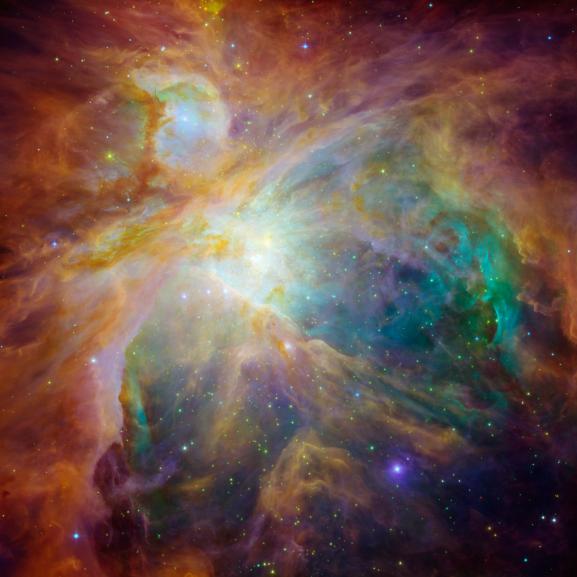
(Source: NASA deep space photo)

Agency demands a problem-space exactly as motion demands regulated (observed) space. Motion is distinguished from space by an observer: space is energy. Thus the discovery that space-time (energy) is at once both a pure sea of light waves folding and crashing in infinite variations as well as a discrete, orderly series of predefined, probabilistic signals, is one of the two great conceptual leaps of this century. The discovery that energy in its very essence is fractured (theoretically, i.e., philosophically) due to this 'fundamental' particle/wave duality is the other, as it accounts for the fact that space (energy) is organized by mutual observation. That is, since time (or energy) is 'broken' (theoretically,) space (practically) has a fractalized topology, and this can be thought of as due to the (unmediated) presence of an observer. The observer converges the subject and the object within a deterministic though dimensionally-problematic space (a 'broken' singularity--no longer merely particles or waves...)

An observer can observe himself. Thus if the nature of the universe depends (in a cosmic sense) on our way of looking at it, then the observer can be expected to introduce not only a sort of polyvocity to objects and a recursive circularity to ideas about reality, but furthermore, the observer can even be expected to produce the universe, by 'breaking' space apart. Thus the observer multiply compounds (through infinite reflections) an inexplicable singularity: he or she produces a meta-mapping of the entire universe into an observed image, and accomplishes the image’s re-projection as the coordinating engine for the entire (real!) universe--all this as though the single observer him or herself contained a bounded though actual infinity. This is how a mirror brings about the fundamental meta-problem of science, that is, the infinite ontological difference between truth and knowledge. The irreducible multiplicity of reflection in observation is a reflection of an irreducible ontological rupture: the habitation of the 'broken space' between image and object, the word and the thing, the map and the territory.

There’s a shift: it is rather as though we had been handed a script not with some fictional scenario traced upon it, but in fact a complete list of all the scenes in which we ourselves as individuals would take part, a final list of all the sentences we would ever utter within those scenes, for the rest of our lives. The fractal twist here would be that some outside observer (in this case me!) is handing you the story: thus in observation we find always a broken co-narrative space, a bi-univocal mutual observation which leads to a curious paradoxical reciprocity: I exist in your 'dream' because you exist (to 'dream me') in mine, and vice versa. Thus we become real only through the reading of each others’ dreams.

But our stories or dreams might still be identical even if identity as such were not cosmically or historically stable, that is, whether we are speaking of the integrity of things, or again, our ideas about things. This is our first evidence that the fundamental unpredictability of the observer’s perspective is an indication of a learning intelligence.

With autopoesis, the scientist must truly turn around to look at himself: moreover, we realize we can only make this turn, as it were, when we have been called. Someone shouts your name: neurons fire, the connection is made, your head turns. The programming in this case is generally so complete we can and often do say we are “turning without thinking.” Yet thinking of a sort is certainly occurring: it is not merely as though we consult a dictionary of syllables to determine if the sound uttered matches our name, but certainly at some level some analogous operation must logically be taking place.

While we would like to say we have free will--and though admittedly this is a biased (but revealing) example-- it is obvious the issue of power and will only apply marginally to this extraordinary 'turning' event. What power indeed do I have (within or against) the encounter with the other; what certainty could falsify the hailing from afar of the same? These sorts of considerations lead us to assert that identity is only brought about through a vigorous process of self-questioning, of a certain uncertainty. Our highly-structured interior 'reality' collapses upon itself in the face of the other, though it remains absolute relative to the encounter. But at some level we know our entire (practico-theoretical) 'house of cards' was constructed in vain the moment he opens his mouth in addressing me--and this only by his or her offering of an alternate reality, through his story, which radically splits my universe in twain, into tiny pieces with crooked and uneven edges. The observer who observers another observer splits a splitted universe: into an image I wish the Other to fall neatly back into, which contrasts with and is unsettled by the jagged, chaotic real space in which nothing sticks and everything flows, regardless of the complexity of the (manual, visual or vocal) dialectics we have constructed to balance all the potential opposing forces.

The Other is the problem par excellence, as well as the enigma in a solution, a riddle whose answer is written upon his or her very face. Our blind spot is always ourselves, but this is the scientists’ positivist abyss: we burn a hole in the universe, and thus of our map of the universe, by our very observation of it--we tear our perceptions apart, into pieces, when we decode them; our affections are untrustworthy, subjective, perilous. But isn’t it here that Nietzsche tells us it is most important to trust our senses, that indeed all the great advances in science have resulted from paying careful attention, to the only thing we can pay attention to--the world around us, as it appears to us, including all the potential distortions and disorganizing chaos?

In fact it is in the chaos of fractal space and the turbulence of flowing photons that we shall seek a more or less final resolution of the central difficulty of computer vision, that is, the reconcilation of the visual and the manual. And even perhaps, after a time, we shall finally be able to learn again that special trust which thousands of years of religion and 'civilization' have all but made extinct... how radical, Nietzsche’s thesis on trusting one’s senses! And how much more troubling, when we realize our senses are always sensed for another, that it is only in mutual observation we observe anything at all!